
The de-husking process
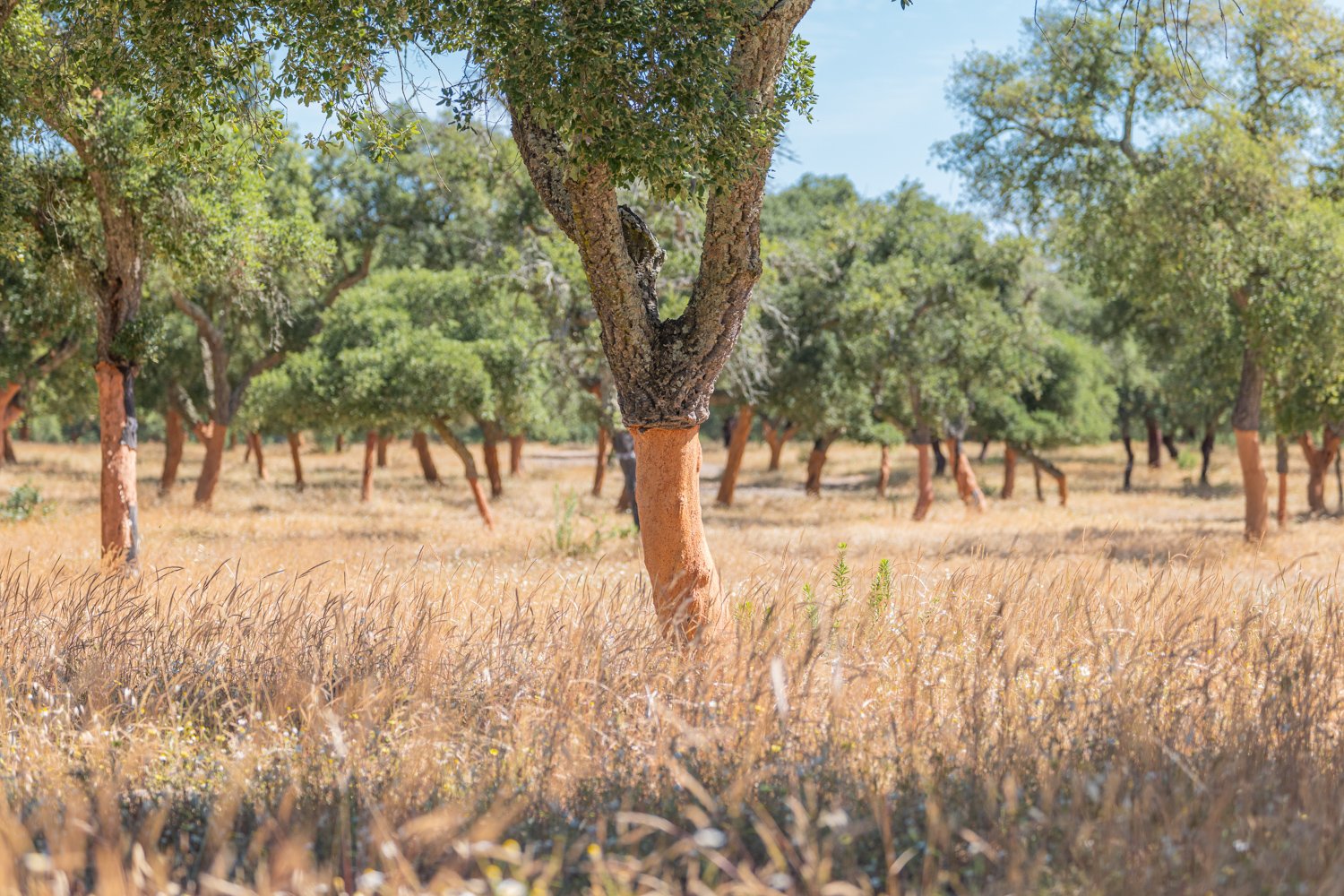
Cork is the name given to the protective bark of the cork oak tree. The cork oak is the only plant species capable of producing the highest-quality cork. It gave rise to an industry that is unique in the world and vital to the survival of the Montado and the Portuguese economy—with cork accounting for 2% of the country’s exports.
Cork harvesting takes place in the Montado, in the Alentejo. The Montado, a forest of cork oak trees, accounts for 23% of Portugal’s forested area. The Montado is also one of 35 global biodiversity hotspots, home to more than 160 species of birds, 24 species of reptiles and amphibians, and 37 species of mammals, including the Iberian lynx. The Montado absorbs 14 million metric tons of CO₂ every year, thereby preventing it from being released into the atmosphere.

The cork oak lives, on average, 200 years. It is only after the first 25 years of this long and fruitful life that cork begins to form on the trunk of the cork oak. During the first harvesting—known as “desbóia”—the cork obtained has an irregular structure and is extremely hard, making it difficult to work with. This “virgin cork” is typically used for flooring and insulation, since it is not flexible enough to be made into cork stoppers.
It is only after the third harvesting that the cork exhibits the properties suitable for making cork stoppers. After each harvest, the cork oak takes nine glorious years to regenerate and yield its cork once again. Over its lifetime, a cork oak will yield, on average, 15 harvests.

Throughout this process, it is absolutely crucial that all necessary precautions be taken to avoid damaging the trees. If a cork oak is damaged, it will be unable to regenerate and produce more cork. For this reason, cork harvesting is performed only by highly qualified professionals. The cork harvesting process is carried out in six stages:
Opening: The cork is struck vertically along the deepest crack in the bark. At the same time, the edge of the axe is twisted to separate the cork plank from the trunk.
Splitting: The cutting edge of the axe is inserted between the plank and the log, followed by a twisting motion of the axe to complete the split.
Marking: The area of the plate to be removed is delineated by a horizontal cut.
Harvesting: The plank is removed with the utmost care to prevent it from breaking. The larger the plank harvested, the higher its market value. Once the first plank has been removed, the process is repeated until all the cork has been removed from the log.
Removal: After the planks have been removed, some cork fragments remain at the base of the trunk. To remove any parasites that may be present in the cork layers of the cork oak, the cork harvester taps the trunk a few times with the head of the axe.
Marking: At the end of the debarking process, each tree is marked with the last digits of the year in which the harvest took place, making it possible to calculate the year in which the process can be repeated.
All harvested cork is put to use, either by using the scraps to make byproducts or by recycling used cork products.