
CLASS 44 micro-agglomerated
// STILL WINES
CORK STOPPER //
Micro-agglomerated cork stoppers are made from 100% raw material derived from the production of natural cork stoppers. They are produced using a perfectly balanced formulation that incorporates microspheres (a chemically inert expanding agent) suitable for food contact, ensuring excellent mechanical and physical properties, as well as a consistent oxygen transmission rate (OTR), thereby promoting uniform wine aging in each bottle.
Traceability of the cork’s origin, combined with granule sterilization and deodorization technology (the MaxClean system), ensures that these corks deliver exceptional organoleptic qualities.
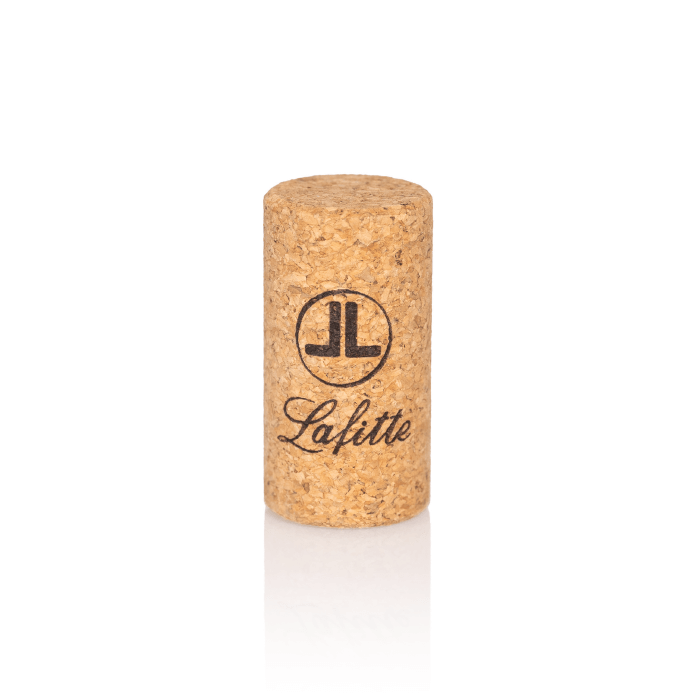
Technical Information
| Length | Diameter | Density | 2,4,6 - TCA(1) |
|---|---|---|---|
| 44 ± 0.5 | 24 ± 0.3 | 280 ± 40 | ≤ 0,5 |
| mm | mm | Kg/m³ | ng/L |
| Chamfer | OI(3) : 6 months |
OI(3) 12 months |
OTR(4) per year |
|---|---|---|---|
| VN(2) ± 0.5 | 0,80 | 1,02 | 0,07 |
| mm | mgO2 | mgO2 | mgO2 |
⁽¹⁾ Content of free TCA, analyzed in accordance with ISO 20752
⁽²⁾ VN = Face Value
⁽³⁾ Oxygen Inlet (OI – Oxygen Inlet)
⁽⁴⁾ Oxygen transfer rate (OTR) per year, after the first year
-
— Use of cork stoppers up to six months after shipment;
— Cork is sensitive to temperature, humidity, and odors, so cork stoppers should be stored in locations:
>that are clean, well-ventilated, and odor-free;
>where the temperature remains between 15°C and 25°C;
>where the relative humidity is between 50% and 65% (if it exceeds 65%, there is a risk of irreversible microbiological changes). -
— Use standard bottles;
— Periodicallycheck the corking machine jaws, which must be clean and free of scratches (which cause creases in the cork);
— The ambient temperature should be between 15ºC and 20ºC;
— Bottle under vacuum or with CO2;
— Respect the nominal filling level of the bottles;
— Clean the machines and wine pipes before and after bottling;
— Do not compress the cork below 2⁄3 of its diameter (this causes changes in structure, poor recovery, or leaks);
— The cork should be ± 0.5 mm from the neck of the bottle;
— Bottles should not be placed in a horizontal position immediately after bottling. They should remain in a vertical position for at least 3 minutes;
— Storage and transport of the product in accordance with regulatory standards.
Please contact us for more information.
Our team is available to answer any questions you may have. You can also use this form to request a free quote for our CLASS 44 corks.