
Agglomerated
// SPARKLING WINES
CORK STOPPER //
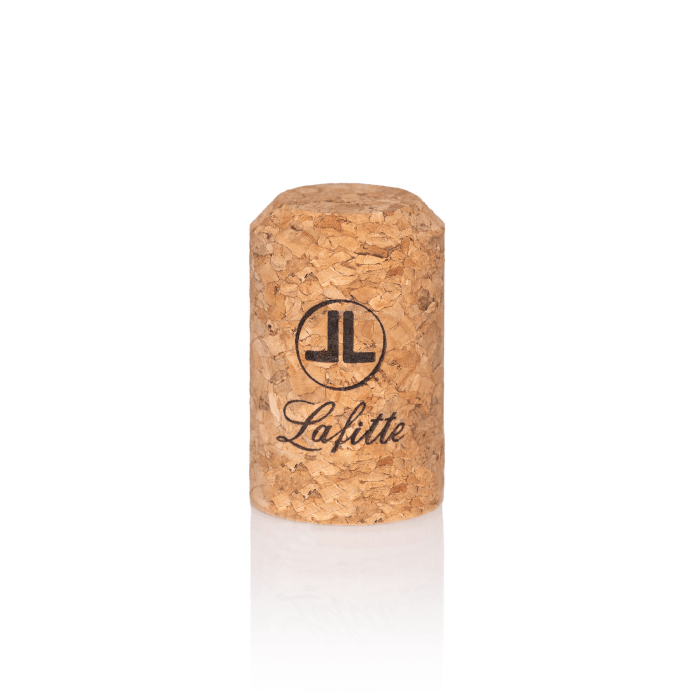
Lafitte applies all of its expertise and technology to the production of agglomerated corks for sparkling wines.
Made from the raw material used in the production of natural corks and discs. The elasticity and springback of the raw material ensure optimal mechanical performance for withstanding the pressures of sparkling wines.
The granules used in its production undergo our MaxClean process to ensure that the cork's organoleptic behavior does not interfere with the wine's sensory profile.
Technical Information
| Length | Diameter | Density | Chamfer |
|---|---|---|---|
| NV ± 0.5 | NV ± 0.4 | 275 ± 25 | NV ± 0.5 |
| mm | mm | Kg/m³ | mm |
-
— Use of cork stoppers up to six months after shipment;
—Cork is sensitive to temperature, humidity, and odors, so corks should be stored in places that are:
> clean, well-ventilated, and odor-free;
> where the temperature remains between 15ºC and 25ºC;
> where the relative humidity is between 50% and 65% (if it exceeds 65%, there is a risk of irreversible microbiological change). -
— Use standard bottles;
— Periodically check the corking machine jaws, which must be clean and free of scratches (which cause creases in the cork);
— The ambient temperature should be between 15ºC and 20ºC;
— Bottle under vacuum or with CO2;
— Respect the nominal filling level of the bottles;
— Clean the machines and wine pipes before and after bottling;
— Do not compress the cork below 2⁄3 of its diameter (this causes changes in structure, poor recovery, or leaks);
— Insert the cork to a depth of 24mm ± 2mm after placing the muselet; — Bottles should not be placed in a horizontal position immediately after bottling. They must remain in an upright position for at least 3 minutes;
— Store and transport the product in accordance with regulatory standards.
Please contact us for more information.
Our team is available to answer any questions you may have. You can also use this form to request a free quote for our agglomerated corks.